
- What are defense mechanisms?
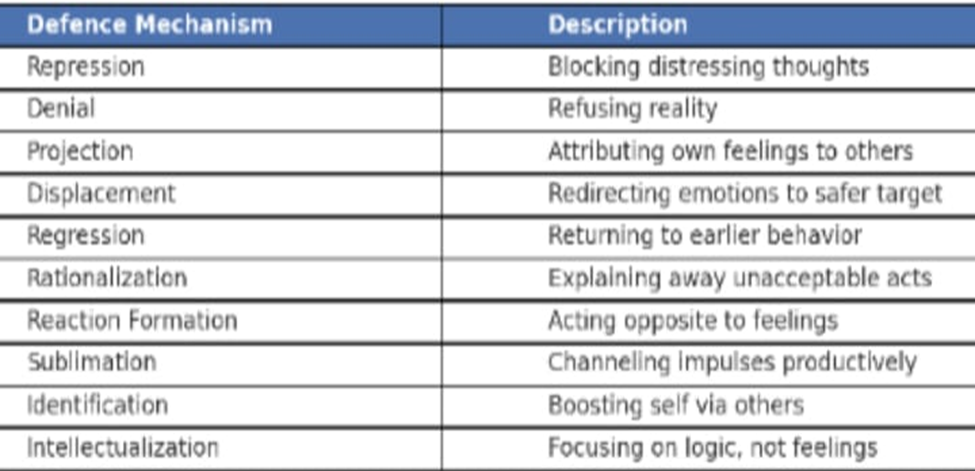
Defense mechanisms can be defined as subconscious strategies used to manage stressful situations and unpleasant emotions. According to Freud’s psychoanalytic theory, these mechanisms may help us maintain our mental health by protecting us from feelings or realities that cause anxiety or distress.
- What are Freud’s defense mechanisms?
Freud’s defense mechanisms are generally mental strategies we use to handle reality and keep our self-image intact. Sigmund Freud introduced these unconscious processes, and they were further developed by his daughter, Anna Freud. They tend to include a variety of mechanisms, like denial, repression, projection, and more, each serving a unique purpose in
managing stress and emotions.
- Repression
Repression can occur when we unconsciously suppress thoughts or feelings that can cause anxiety or distress, preventing these emotions from reaching our conscious mind. An example of repression could be forgetting traumatic events from childhood, making it easier to cope with day-to-day life.
- Denial
In general, denial is when we refuse to accept reality, shutting out external events from our awareness. Denying reality normally allows a person to avoid confronting situations that might be too challenging or overwhelming. For example, a person might deny having an addiction to alcohol or refuse to accept that a loved one has been diagnosed with a serious illness.
- Projection
Projection is generally understood as a defense mechanism that protects self-esteem by externalizing undesirable aspects of the self.
Projection, which Anna Freud also called displacement outward, is almost the complete opposite of turning against the self. It involves the tendency to see your own unacceptable desires in other people. In other words, the desires are still there, but they’re not your desires anymore.
For example, Thoughts most commonly projected onto another are the ones that would cause guilt such as aggressive and sexual fantasies or thoughts.
For instance, you might hate someone, but your superego tells you that such hatred is unacceptable. You can ‘solve’ the problem by believing that they hate you.
- Displacement
Have you ever had a really bad day at work, then went home and took out your frustration on family and friends? If you answered yes, you have experienced the ego defense mechanism of displacement, involves taking out our frustrations, feelings, and impulses on people or objects that are less threatening.
Displaced aggression is a common example of this defense mechanism. Rather than express your anger in ways that could lead to negative consequences (like arguing with your boss), you instead express your anger toward a person or object that poses no threat (such as your spouse, children, or pets.)
- Regression
Regression normally occurs when we revert to an earlier stage of development or behavior when faced with stress or conflict. Regressing may allow us to return to a time when we felt more secure or comfortable. For example, an adult might start sucking their thumb or acting overly dependent when they’re under extreme stress at work or in their personal life.
- Reaction Formation
Reaction formation reduces anxiety by taking up the opposite feeling, impulse, or behavior. An example of reaction formation would be treating someone you strongly dislike in an excessively friendly manner in order to hide your true feelings.
Why do people behave this way? According to Freud, they are using reaction formation as a defense mechanism to hide their true feelings by behaving in the exact opposite manner.
- Sublimation
Sublimation is similar to displacement, but takes place when we manage to displace our unacceptable emotions into behaviors which are constructive and socially acceptable, rather than destructive activities.
Sublimation for Freud was the cornerstone of civilized life, as arts and science are all sublimated sexuality.
For example, many great artists and musicians have had unhappy lives and have used the medium of art of music to express themselves. Sport is another example of putting our emotions (e.g., aggression) into something constructive.
Intellectualization
Intellectualization typically involves distancing ourselves from our emotions by focusing on the logical aspects of a situation. Intellectualizing may allow us to avoid coming face-to-face with painful emotions. For example, someone who has just lost a loved one might concentrate on planning the funeral and sorting out legal matters rather than processing their grief.
- Identification
Identification can be seen as the process of adopting the qualities or characteristics of someone else, often subconsciously, to feel more secure or manage anxiety. Identifying with another person can help us feel like we belong and cope with our feelings of insecurity or inadequacy. For example, a teenager might copy the behavior and style of a popular peer to fit in and gain acceptance.
Seven main defense mechanisms, which are denial, displacement, projection, rationalization, reaction formation, repression and sublimation